
One Offer, Ten AI Videos: Why Do the Creatives Stop Feeling Like the Same Campaign?
The first video shows a traveler placing a red carry-on backpack beneath an airplane seat. The second puts the same backpack in a crowded train station. The third begins with someone packing it for a weekend trip.
The campaign still feels connected.
By the sixth video, the backpack has become burgundy. By the eighth, the audience has shifted from light travelers to outdoor hikers. In the final clip, the main message is no longer about avoiding checked luggage. It is about looking stylish in the city.
Each video may look good on its own. Together, they feel like ads for several different products.
That creates a practical problem for the media buyer. When the product, audience, promise, and format all change at once, it becomes difficult to tell what actually caused a difference in performance.
The backpack campaign below is hypothetical, not a report from a real test. It shows how affiliate marketers and media buyers can create useful variation without allowing one offer to turn into ten unrelated stories.
Each Prompt Can Quietly Rewrite the Campaign
The original offer is simple: a compact carry-on backpack for people who want to travel with less luggage.
The first creative focuses on fitting the bag beneath an airplane seat. The next prompt asks for a younger traveler, a faster edit, and a busier location. Another introduces a mountain setting because the airport scenes feel too similar.
None of these changes seems serious by itself.
After several rounds, however, the original brief becomes harder to see. The audience changes, the use case changes, and the main promise becomes less specific.
Different settings are not the problem. A campaign needs different hooks and visual approaches. The problem begins when each creative starts making new decisions about the offer itself.
Lock the Elements That Define the Offer
Before generating ten videos, write a short campaign card.
For the hypothetical backpack, it could include:
- Product: the same compact red travel backpack
- Audience: short-trip travelers trying to pack lighter
- Main promise: practical storage without checking a larger bag
- Supported wording: fits beneath many airline seats
- Visual constants: shape, color, pockets, straps, and approximate scale
- Destination: the same landing page and purchase action
These details should not be decided again inside every prompt.
The wording also needs to match the landing page. If the advertiser cannot support universal airline compatibility, a creative should not change “fits beneath many seats” into “accepted by every airline.”
Product state matters as well. A fully packed bag should not become a flat fabric pouch in the next video without a reason. Its size should not change dramatically when placed beside a suitcase or under a seat.
Small visual changes can alter what the audience believes about capacity, material, or intended use—even when the voice-over stays the same.
Decide What the Creatives Are Allowed to Change
Campaign consistency does not mean producing the same video ten times.
The airport, train station, and packing-room scenes can all belong to one campaign. The opening question, camera distance, pacing, demonstration, and order of benefits can also change.
What matters is that these changes are deliberate.
One creative might begin with a baggage-fee problem. Another may show how someone packs for two days. A third can demonstrate the backpack sliding beneath a seat.
Those are different routes to the same offer.
The product identity, intended audience, supported promise, destination page, and required disclosures remain fixed. The hook and presentation become the test variables.
This is the practical meaning of keeping AI video creatives consistent across one campaign: the videos can look different while still making the same commercial argument.
Avoid Changing Five Variables at Once
Suppose Creative A uses an airport, a practical voice-over, and a close product demonstration.
Creative B changes the setting to a train, removes the voice-over, introduces a different audience, adds a new benefit, and tells a more emotional story.
If B performs differently, the team learns very little. Any one of those changes—or their combination—may have caused the result.
A cleaner test would keep the offer, audience, product view, and final action stable while changing only the opening hook:
“Still paying to check a bag?”
“Can a weekend fit under one seat?”
“What would you leave behind for a two-day trip?”
The visuals do not need to be identical. They only need a clear testing relationship.
If several variables must change, record them before production. Otherwise, a creative that appears to be a new hook may quietly become a different audience and offer test.
Review the Campaign as Still Images
Here is a useful counterintuitive check: look at the ten creatives before watching them.
Capture the opening frame, clearest product frame, and closing frame from each video. Arrange them as a simple contact sheet.
Ignore the motion, music, captions, and transitions.
Does the backpack still look like the same item? Are the videos speaking to the same kind of traveler? Do the closing frames point toward the same action? Do the colors and overall tone feel related without becoming identical?
If the campaign already falls apart as a set of still images, stronger editing is unlikely to repair it. The problem probably sits in the brief, references, or product instructions.
The contact sheet can also reveal the opposite problem: ten creatives that are so similar that they do not test anything meaningful.
Start With Three Creatives, Not Ten
Begin with a small batch:
- A direct product demonstration
- A problem-first scenario
- An audience-specific travel situation
Compare those three videos with the campaign card.
Once the offer sheet and the first three shot cards are locked, Wan 3.0 can be introduced as the generation step—not as the place where the campaign brief is decided.
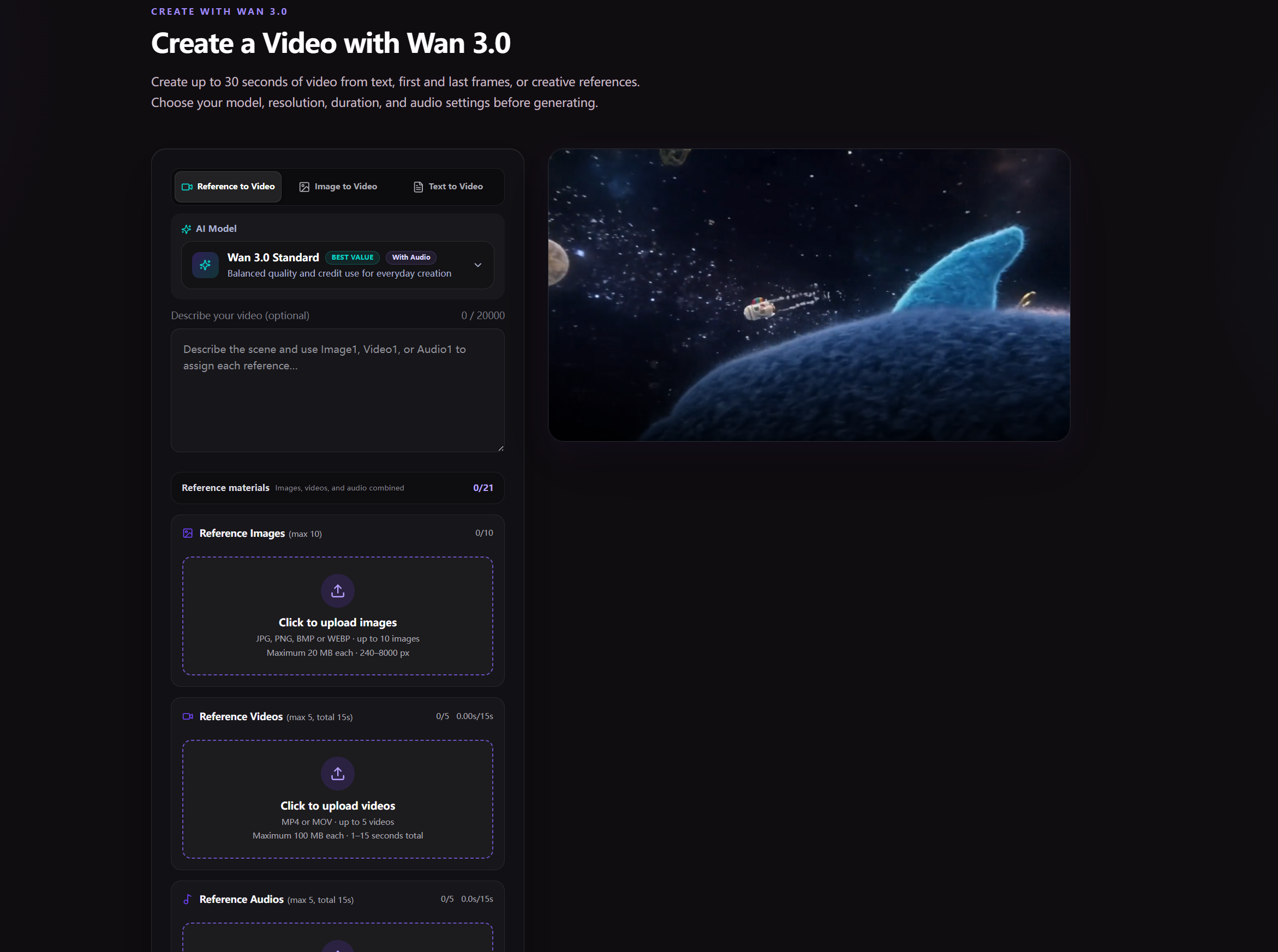
Separately generated videos should not be assumed to preserve every product and campaign detail automatically. Review the first batch before producing the remaining versions.
Finding a drifting product color in Creative 3 is easier than discovering the same problem across ten finished exports.
A Short Pre-Launch Check
Before putting the creatives into rotation, ask:
- Does every video communicate the same offer?
- Are all claims supported by the landing page?
- Does the product keep the same shape, color, material, and scale?
- Is the intended audience still clear?
- Does each creative change a deliberate variable?
- Can the team explain what each version is testing?
- Do all videos use the correct destination and disclosures?
- Do the opening, product, and closing frames still resemble one campaign?
Ten videos do not become a campaign simply because they share a folder name.
The airport, train station, and packing-room videos can look different. The red backpack, the light-travel promise, and the destination page should not.
Рекомендовані статті